Any Random Tuesday
Life, art and taste. The same untangling, pointed at everyday things.
anyrandomtuesday.com
Nurse, operator, builder. I take tangled things and make them legible.
I started in 2011 as a dialysis technician, one treatment at a time. Since then I’ve sat in seven seats: the chair, the bedside, the floor, the unit, the account, the territory, and now the system. Every seat optimizes for what it can see, and every seat has a blind spot. I’ve sat in enough of them to read a system from the positions that can’t see each other.
For most of that time a missed detail could cost someone their life. Forget to screw on a cap in a circuit and blood leaks when you walk away. That’s where my attention to detail comes from. Industry added the other half: knowing where a shortcut is affordable, and where it never is.
Tools give people access. They don’t give them mastery. My talent may not be dialysis-specific at all. What I do is take tangled things and make them legible, and these days I do it in three places.
The same skill, pointed at three different tangles. Each one is live.
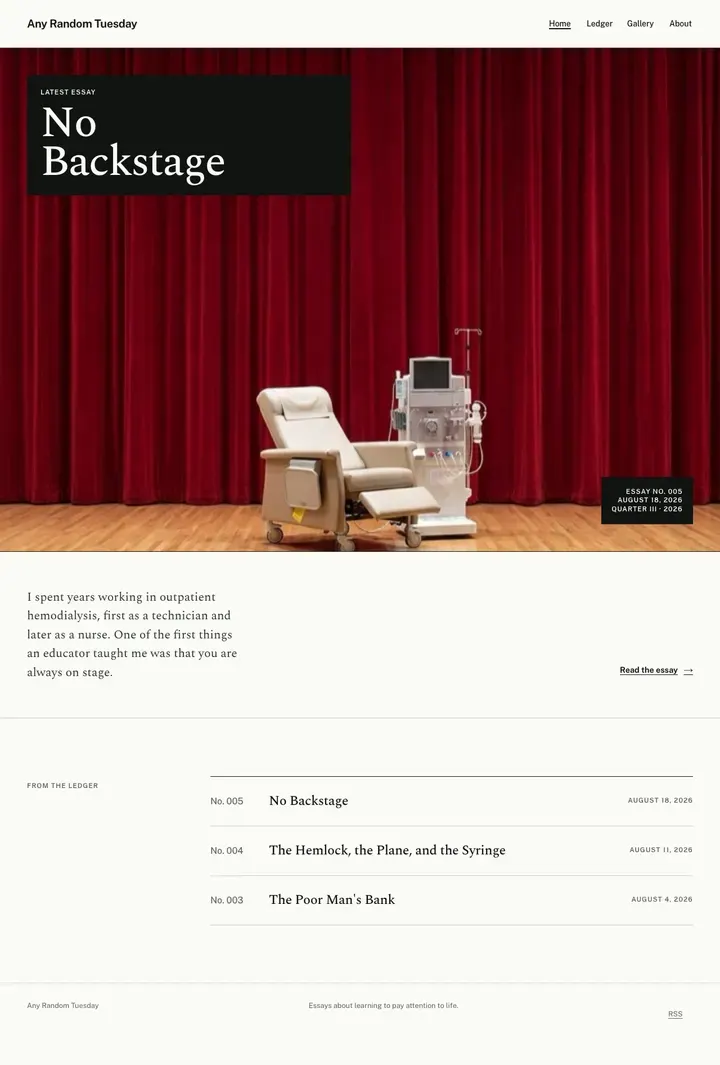
Life, art and taste. The same untangling, pointed at everyday things.
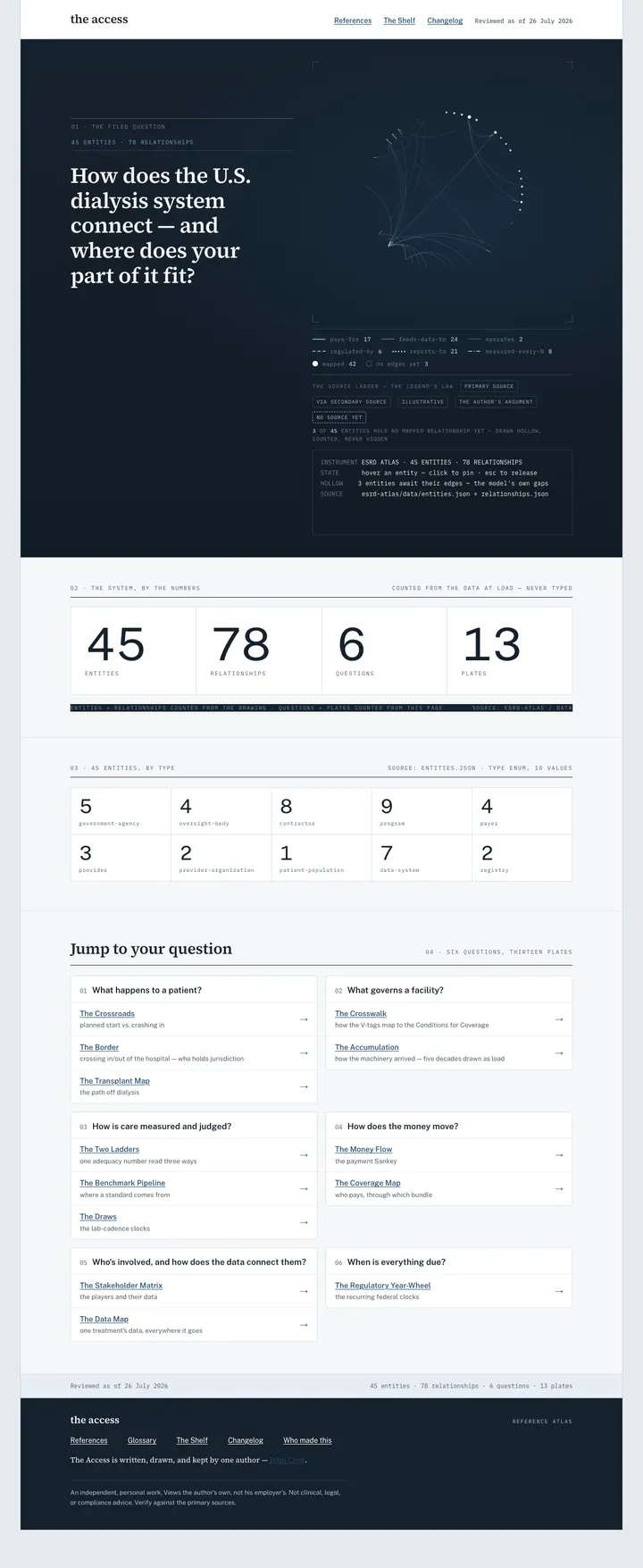
anyrandomtuesday.comHow the U.S. kidney-care system actually connects: the care, the money, the rules. Thirteen plates so far, every claim sourced and dated.
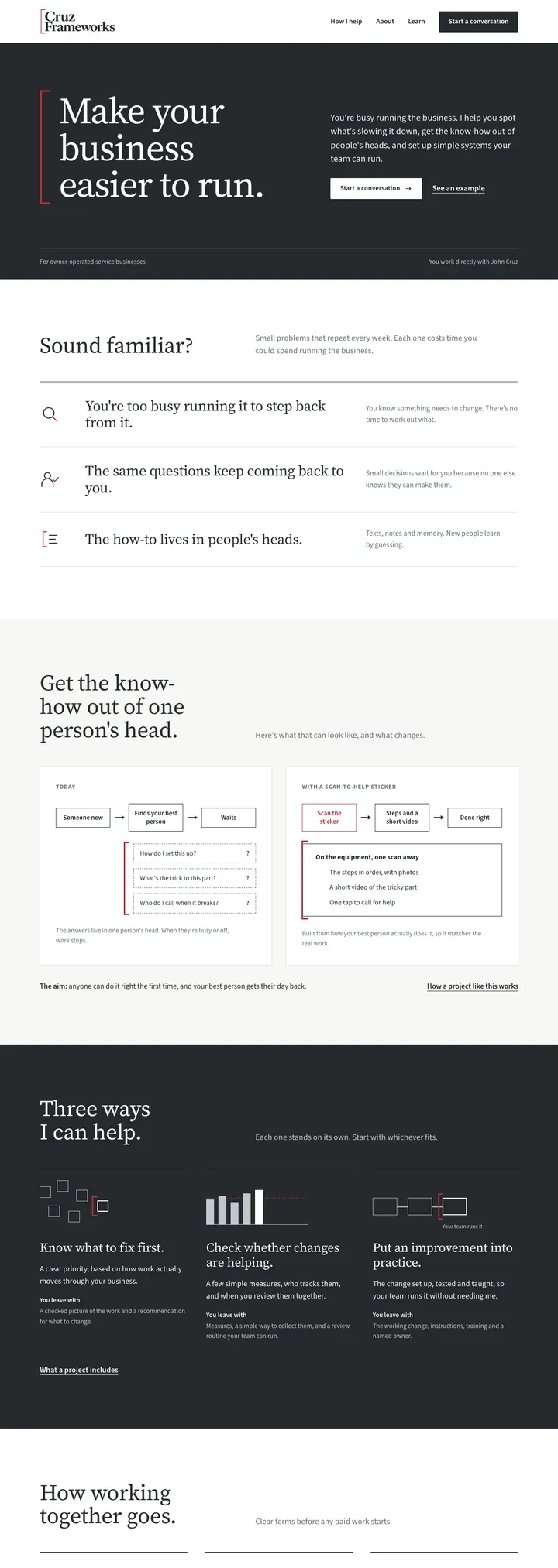
the-access.coThe practice. Workflow diagnosis and design for small service businesses, for when the work has outgrown how it’s organized.
cruzframeworks.comSeven seats, 2011 to now, from the dialysis chair to the whole system. Open any seat for what it could see, what it couldn’t, and what carried forward.
What I could seeThe treatment in front of me: needle placement, machine parameters, the full prescribed time, so lab day tells the truth.
What I could notAnything above the unit. I didn’t know the Conditions for Coverage existed.
Carried forwardI was a tech in one of those clinics when my license came through. Promoted in the building.
What I could seeMy section and everyone in it: delegation, medications, catheter care, infection surveillance. In acute, whatever the patient walked in with, alone at the bedside with no second nurse coming.
What I could notContinuity. Wider reach, less person; in acute you treat someone once and never see them again.
Carried forwardOne of these units I staffed first and came back later to run.
What I could seeEvery patient on the shift, the staff, the manager looking to me. The whole floor was my problem, not my section.
What I could notWhere the structure came from: who above the floor decides how a unit runs, or why.
Carried forwardYears later, four sites of this organization would land in my sales book.
The turnThe first time, I was pushed in early and learned that being good at the work is very different from managing people. I stepped back to the floor, and went deep on leadership after.
What I could seeWhy they call it middle management: squeezed between the floor you have to understand and the leadership you answer to.
What I could notHow far the chain runs above you.
Carried forwardI came back to run the unit I once worked.
What I could seeThe unit from outside, across nine of them. Even the best solution asks people to trade problems they have mastered for new ones; no sale skips that.
What I could notThe full picture. I was incentivized for adoption, not for what the unit carried after I left.
Carried forwardAll nine came with me into the manager’s book.
What I could seeThe region: how programs differ hospital to hospital across the hardest room I have sold into. Selling there took clinical credibility and commercial fluency in the same person. I was carrying both.
What I could notThe inside of the accounts. A book that wide is held through your reps; you see the coverage, not the chair.
Carried forwardAll nine rep accounts, still in the book. And four sites of the organization I once charged in, covered from the outside this time.
What I could seeNo orders to follow: the first seat where the problem arrives with no protocol attached. I look for the constraints first, then build inside them.
What I could notThe chair. I am further from the bedside than I have ever been. The seat that finally sees the whole system is the seat that stopped touching it.
Carried forwardThe Conditions for Coverage I didn’t know existed in 2011 are what I work inside every day.
Registered nurse, New York and Massachusetts. BSN.
Nobody asked for any of these. Each one fixed something I could see from my seat.
A care team was preparing for weekly rounds from scattered notes. I built shared lists for patient panels, due dates and rounds, so everyone prepares from the same screen.
A 37-station unit’s patients set into one standing template: appointment times, treatment lengths that move with the orders, the chair each person is used to. It assembles like Sudoku. Fewer grievances, per the unit’s record.
A chair could be ready while the floor had no idea the patient had arrived. A tablet at the front desk and one shared sheet fixed the handoff: marked at the door, seen on the floor.
Schedules, documents and preventive maintenance by device, in one place instead of several inboxes. Built from tools the unit already had.
The help-desk number lived on a sticky note. I replaced it with a code on the machine that dials the service line directly.
A second code on the same machine: the manual, the steps, and short looping clips of the actual motion of seating the acid and bicarb wands. Instructions describe the motion. The clip shows it.
A regional team working remotely, each person carrying their accounts in their head. One internal site put the whole book in front of all of us.
If something here maps to a problem you’re carrying, or you just want to think out loud about how a system works, write. I read everything and answer what I can.
If you came for the practice rather than the person, it’s at cruzframeworks.com.
Received.
Thanks. I’ll write back.